

Content - Page 11
- Details
 Emergency and critical care (ECC) is specifically concerned with the stabilisation and treatment of seriously unwell patients. Both the out of hours (OOH) team and the daytime intensive care unit (ICU) team are tasked with monitoring and providing ongoing care for these patients, in conjunction with other specialist services at the hospital.
Wear Referrals is fortunate to have a dedicated ICU, specifically for monitoring and caring for patients with more complicated needs whose condition may change suddenly. These patients are admitted through our referral services, or the OOH service and admitted to ICU if their condition is thought to require intensive treatment.
The ICU is maintained 24 hours a day by a dedicated team.
Wear Referrals has a range of equipment to help the staff monitor and provide treatment to patients, including oxygen points next to the kennels; ECG monitoring; blood pressure monitoring; oxygen saturation monitoring and ultrasound. We also have access to a defibrillator and dedicated ‘crash trolley’ for the most serious emergencies.
What cases are treated?
ICU cases can include patients with tracheostomy tubes and airway problems; patients with signs of shock who need intensive fluid therapy; patients suspected of having seizures and patients with arrhythmias; acute renal failure; diabetic ketoacidosis; unstable diabetics; complex endocrine disorders; patients requiring blood transfusions.
Patients recovering from certain surgical or medical procedures may be placed in ICU after their procedure until they are more stable. The facility and associated level of care is available to any patient attending Wear Referrals whose condition requires it.
- Details

Brian Love heads our cardiology service at Wear Referrals and is for patients with known or suspected heart disease. Indications for referral include the investigation of heart murmurs or arrhythmias, syncope or episodic weakness, or dyspnoea.
Diagnostic procedures will be carried out after a careful initial assessment. Further diagnostic procedures may include blood tests, thoracic radiography, electrocardiography (ECG) and echocardiography (cardiac ultrasound), including spectral and colour flow Doppler.
We also carry out 24-hour ECG monitoring (Holter) for the investigation of intermittent syncope and diagnosis/monitoring of arrhythmias.
Multi-disciplinary approach
The cardiology department works closely with our internal medicine and soft tissue services.
Patients with clinical signs caused by airway disease are transferred to the internal medicine service for further investigations, such as bronchoscopy or thoracic CT.
Patients requiring thoracic surgery are treated by the soft tissue service - for example, pericardiectomy (removal of the sac around the heart) for recurrent pericardial effusions and surgical closure of patent ductus arteriosus (PDA) in patients unsuitable for transcatheter closure.
Cardiology procedures
- Doppler echocardiography
- Electrocardiography
- Holter monitoring
- Details
 Internal medicine involves diseases affecting internal organs and systems. We utilise various techniques and equipment to help us reach a diagnosis, including diagnostic imaging, clinical pathology and endoscopy. We also work closely with other services within our hospital, as one of the strengths of Wear Referrals is drawing upon the joint expertise of vets specialising in different disciplines.
We also benefit from a dedicated intensive care unit, which allows high-level care to be delivered around the clock to critically ill patients.
All veterinarians working within our service in County Durham are either training towards, or already possess, specialist status in internal medicine, awarded by the Royal College of Veterinary Surgeons or the European College of Veterinary Internal Medicine. This is the highest level of clinical qualification currently available.
A dedicated team of Registered Veterinary Nurses (RVNs) work alongside the clinicians to afford the best possible standard of care to patients within our service.
In addition to seeing patients referred to us, we are happy to provide free advice to vets in practice on request.
Internal medicine conditions that we investigate and treat:
- Endocrine conditions - hypoadrenocorticism, hyperadrenocorticism, diabetes mellitus, hyperaldosteronism, diabetes insipidus, pheochromocytoma.
- Swallowing disorders, including barium swallow fluoroscopy using our digital fluoroscopy unit, and an inter-disciplinary approach with our neurology team.
- Respiratory disorders - investigations of chronic cough, tachypnoea, dyspnoea, pleural effusions, sneezing, nasal discharge, and epistaxis- often involving the use of CT, bronchoscopy and bronchoalveolar lavage, rhinoscopy and nasopharyngoscopy.
- Hepatobiliary disease - investigation and treatment of jaundice, increased liver enzymes, suspected portosystemic shunts, biliary disorders, hepatic lipidosis. Often using abdominal ultrasound, multi-phase contrast CT studies, and laparoscopic liver biopsies.
- Gastrointestinal conditions, including investigation of chronic diarrhoea, vomiting, regurgitation, weight loss, suspected malabsorption, dyschezia, haematochezia, perianal fistulas.
- Renal and urinary disorders – acute or chronic azotaemia (including intensive management of acute renal failure), dysuria, urinary incontinence, urinary obstruction, urolithiasis, haematuria, recurrent urinary tract infections.
- Pancreatic disease - acute and chronic pancreatitis, pancreatic insufficiency.
- Haematologic and immune-mediated disease – including immune-mediated haemolytic anaemia, thrombocytopenia, or neutropenia; non-regenerative anaemia; immune-mediated polyarthritis, ulcerative or erosive skin or mucosal disease such as lupus and pemphigus-type disease, leukaemias, myasthenia gravis.
- Oncology - diagnosis and treatment of neoplasia or suspected neoplasia, adopting a multi-disciplinary approach. We have a dedicated chemotherapy suite for providing ongoing outpatient care for oncology patients.
- Other clinical signs commonly investigated by the medicine department: polyuria, polydipsia, polyphagia, reduced appetite, weight loss, unexplained weight gain, abdominal distension, abdominal pain, malaise, hypersalivation, pain on opening jaw, muscle-wasting, pyrexia of unknown origin.
A well-equipped in-house laboratory, including endocrine and PCR testing, support all services.
What's new in our Internal Medicine department?
- Our department is getting involved in a multi-centre study regarding immune mediated anaemia and Pancytopenia (low red and white cells in cats)
- Now the UK has access to treatment of FIP in cats, this was previously a fatal condition and now we can offer treatment with promising results. We currently have several cats at Wear Referrals on this therapy.
- We have expanded the medicine team to include a medicine resident and medicine intern, and keen to raise and train our own specialists.
- We have invested in a new gastroscope to allow better visualisation during endoscopy and to aid obtaining minimally invasive biopsy of the stomach and intestines.
- We have invested in a new cystoscope to allow better access and visualization of the urinary tract in dogs. Cystoscopy now allows us to biopsy the bladder and urethra via a minimally invasive approach.
- We offer FreeStyle Libre monitoring for our diabetic patients. Instead of hourly blood glucose samples being taken (which lead to prolonged hospitalisation and increased stress to the pet), we can apply a glucose sensor to the skin which can stay in place for up to 14 days. This also allows the patients to be discharged from the hospital and allows ease of monitoring at home.
- We can offer fluoroscopy which allows real time live visualisation (a live x-ray is how I explain it to the owner) , this can be performed with or without anaesthesia, which is useful to identify swallowing problems and dynamic airway collapse which can be difficult to diagnose on a static image.
- We offer balloon dilation via endoscopy to dilate any strictures (narrowing of the oesophagus) leading to swallowing problems.
- Details
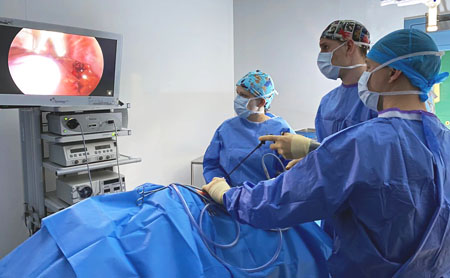
With one of the largest and most highly equipped Specialist-led soft tissue surgery services in the North East, we provide tailored care and treatment options to meet the needs and circumstances of individual pets and their owners.
Our EBVS European Specialists in surgery have further refined skills and experience to excel in the field of soft tissue surgery. They are scientifically trained with over 50 papers and articles published between them in scientific journals, and they care for pets as they would their own.
Our approachable team take the time needed to discuss treatment options with pet owners, tailoring treatment plans and ensuring they are fully informed and happy, understanding that there is no-pressure to go ahead with treatment but offering advanced diagnostic tests and treatments appropriate for the health problem.
Our soft tissue service is led by Professor Jon Hall, working alongside ECVS Specialists Anna Cronin, Laura Homer, Emily Frapwell and the team of nine dedicated soft tissue nurses, providing the highest quality of care.
We accept referrals in all areas of soft tissue surgery and work closely with colleagues in our other departments, including internal medicine, diagnostic imaging, oncology, cardiology and anaesthesia, to ensure patients referred to us receive comprehensive clinical care. Our equipment and facilities allow us to perform laparoscopy and thoracoscopy, interventional radiological and complex surgical procedures.
At Wear Referrals, we are one of very few centres in the north of England to be able to offer this genuinely multi-disciplinary approach, and we firmly believe that, due to the complex nature of many soft tissue cases, it enables us to offer the best standard of care for our patients.
Wear Referrals boasts extensive in-house diagnostic facilities, including a laboratory, endoscopy, CT, 1.5T MRI and in-theatre fluoroscopy with digital subtraction capability.
We offer fixed price packages for select procedures to provide peace of mind with certainty around costs for pet owners. Our fixed price packages include BOAS (brachycephalic obstructive airway surgery), laparoscopic spays, total ear canal ablation, liver biopsies and perineal hernia.
Common surgeries
Ear, nose and throat
- Brachycephalic Obstructive Airway Syndrome (BOAS) surgery
- Laryngeal tieback
Total ear canal ablation & lateral bulla osteotomy (TECA-LBO)
- Oncological surgery
- Tumour excision +/- reconstruction
- Maxillectomy/mandibulectomy
Gastrointestinal
- Oesophageal surgery
- Cricopharyngeal achalasia
- Stomach - e.g. pyloroplasty, partial gastrectomy, GDV
- Intestinal, including rectal and anal, surgery
Urinary surgery
- Ectopic ureters
- Colposuspension
- Hydraulic urethral occluder placement
- Prostatic cyst or abscess management
- SUB placement
Other abdominal surgery
- Liver lobectomy
- Adrenalectomy
- Partial pancreatectomy
- Portosystemic shunt surgery, including portography and portal pressure measurement where indicated
Cardiothoracic surgery
- Pericardectomy
- Lung lobectomy
- Thoracic trauma
- Patent Ductus Arteriosus (PDA) ligation (e.g. for patients that are too small for interventional procedures)
- Vascular ring anomaly
Hernia surgery
- Including perineal, diaphragmatic, peritoneo-pericardial
Reconstructive surgery/wound management
- Subdermal plexus/axial pattern flaps
- Free skin grafting
Minimally invasive surgery
- organ biopsies (liver, pancreas, lymph node, kidney)
- ovariectomy (lap spay)
- pericardiectomy
- cholecystectomy
- gastropexy
- Details
Discrepancies in the relative growth of paired bones or trauma to growth plates can cause growth deformities to develop. Growth deformity is most commonly seen in canine forelimb affecting the distal ulnar growth plate. If pain or lameness is associated with a growth deformity, correction may be indicated.
At Wear Referrals, we have extensive experience in the correction of growth deformities. Often, the most accurate way to resolve all components of a growth deformity is with hinged circular fixation.
This technique is an advanced surgical procedure and, as such, we will routinely perform radiographs and CT and have stereolithographic models made of the deformity. This allows us to pre-design and pre-build a frame for correction specific to each patient and we can rehearse the surgery on the model.
This technique dramatically reduces surgical time and increases the accuracy of deformity correction.
 Correction of an antebrachial deformity using hinged ring fixation
 Correction of Pes Varus in a Dachshund using hybrid fixation
- Details
At Wear Referrals, w offer a custom cutting guide, reduction guide, and 3D titanium custom manufacture of implants for cases requiring patient-specific implants. Some case examples are illustrated below.
Case 1
Acute correction of an antebrachial growth deformity in a Corgi treated by Wear Referrals. In conjunction with design software, CT imaging was used to design and manufacture a duel-angled cutting guide, reduction guide and 3D-printed titanium custom plate to acutely correct this dog’s deformity.
 Case 1 examples
Case 2
Shoulder arthrodesis in a Ridgeback. Custom cutting and reduction guides and 3D printed models were used in this case to ensure precise cuts to the bones to be fused, as well as allow pre-contouring of the plates prior to surgery, dramatically reducing surgical time and increasing accuracy.
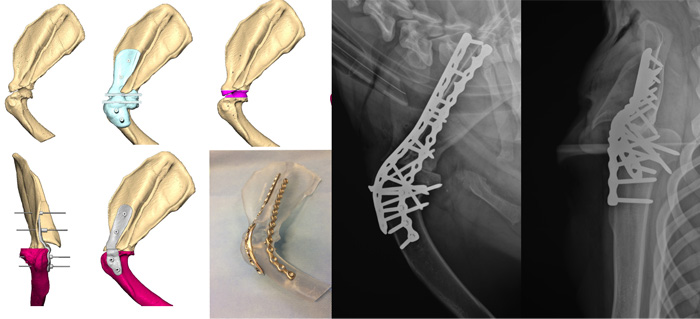 Case 2 examples
- Details
Primary bone tumours of the distal radius, such as osteosarcoma, can be treated by en bloc resection of the tumour and placement of a BioMedtrix porus titanium spacer.
Custom-designed bridging locking plates are made for each individual patient. This technique, combined with platinum-based chemotherapy, can extend patients’ survival time.
 Limb Sparing Surgery
- Details
Arthroscopy, or keyhole surgery, allows a minimally-invasive assessment of the cartilage in the joint. We are equipped with 1.9mm, 2.4mm and 2.7mm arthroscopes at Wear Referrals, as well as a full array of arthroscopic instrumentation.
 (1) Thermal Capsulorrhaphy - (2) Biceps Tenotomy - (3) Humeral Head Osteoarthritis
 (1) Probing Cartilage - (2) Fragment Removal - (3) Abrasion Chondroplasty
- Details
We’re equipped with a comprehensive array of implants for fracture stabilization in cats and dogs, including IMEX mini, small and large linear; hybrid and circular external fixation; BioMedtrix iLOC interlocking nail and 2.0, 2.4, 2.7 and 3.5mm Synthes locking plate systems and polyaxial locking plating systems, including Evolox and Securos PACS.
This extensive range of implants available at Wear Referrals allows us to select the most appropriate means of fracture stabilisation for your patient.
 Humeral condylar Y fracture repair stabilized with bilateral polyaxial locking plates and screws
 TIbial fracture repair stabilized with a BioMedtrix iLOC interlocking nail via a minimally invasive approach
 Open humeral fracture stabilized with an IMEX hybrid external skeletal fixator
- Details
Tarsus
 Stabilisation of a shearing injury of the hock with an IMEX hybrid fixator
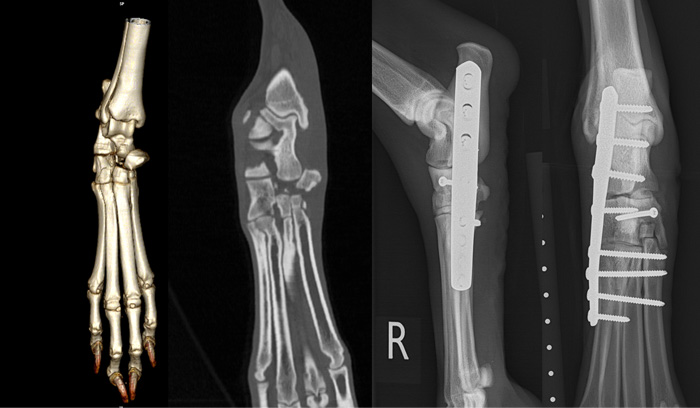 Partial tarsal arthrodesis due to multiple tarsal bone fracture / luxation
 Pantarsal arthrodesis due to talocrural disruption / talar fracture
Subcategories
Page 11 of 13